On the shore of the Caspian Sea, in the heart of ancient Baku, deep inside the maze of narrow lanes of the Old City, stands a mysterious stone tower. Heavy, silent and almost grown into the rock, it has seen so many sunrises and sunsets that it has become part of the horizon itself. Its walls have heard the prayers of pagan priests, reflected the light of ancient Zoroastrian ritual fires, and may have witnessed the birth of people who were called the descendants of the Sun. This ancient building is wrapped in mystery: no legend can fully explain its history, and every new theory only adds more questions. According to local people, the tower witnessed a broken heart, a young woman’s tears and, finally, a tragic end.
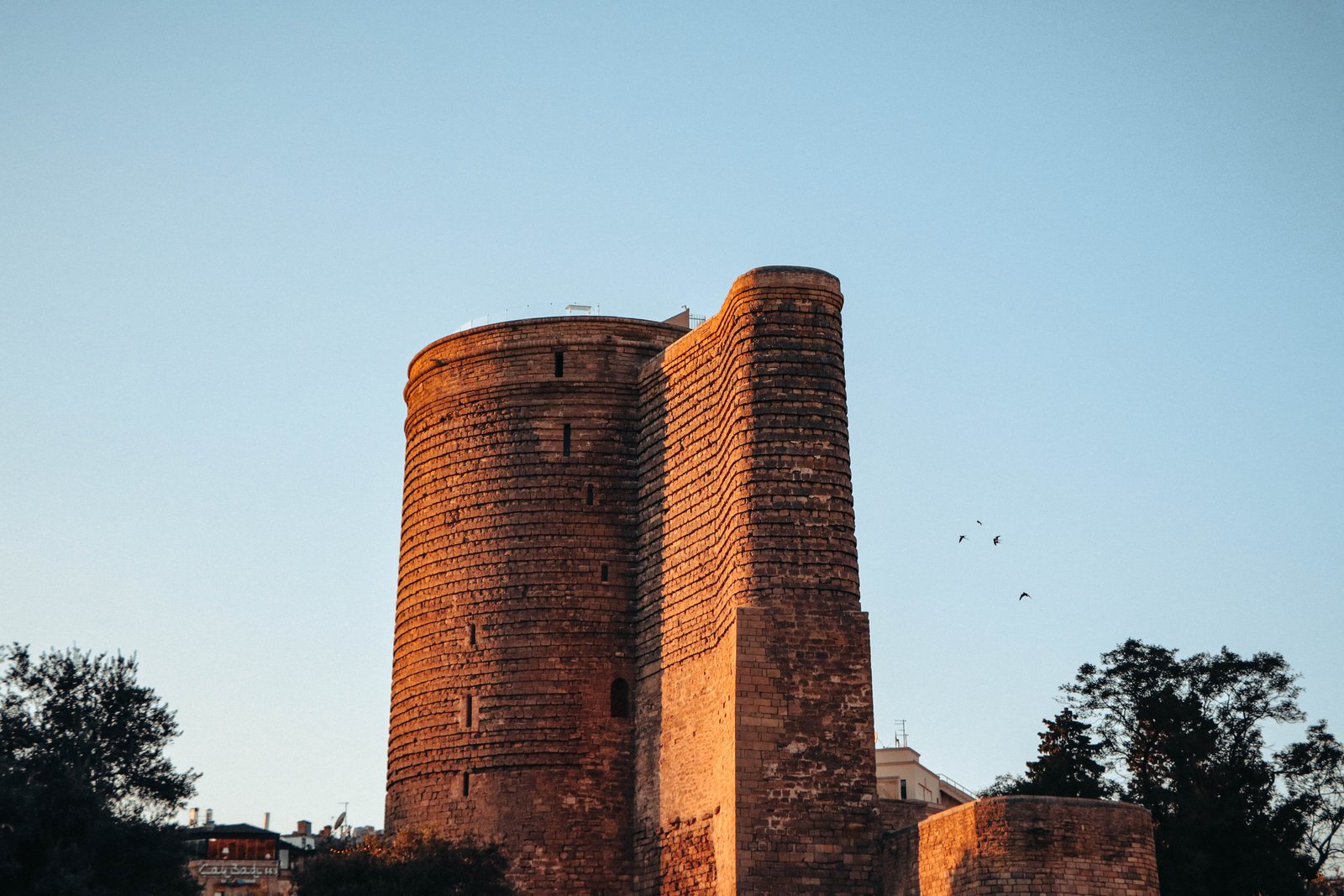
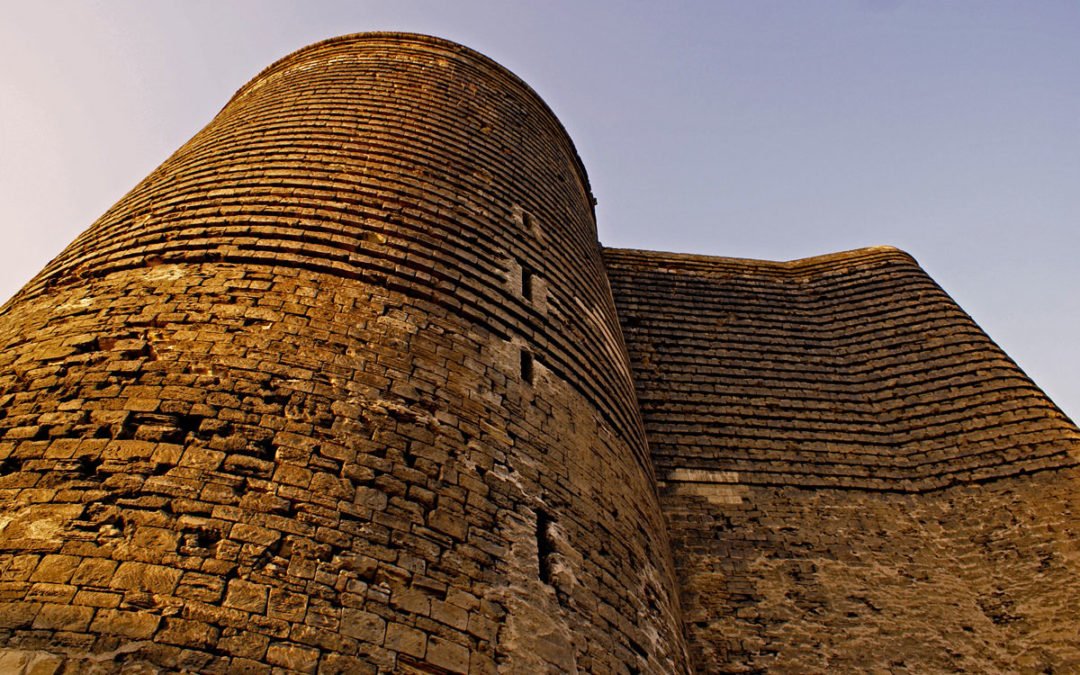
This is the Maiden Tower, one of the oldest and most mysterious architectural monuments in Baku. Its massive cylindrical silhouette, about thirty meters high, with a strong buttress on one side, has long been a symbol of Old Baku. The tower is part of the UNESCO World Heritage Site, together with the Old City and the Palace of the Shirvanshahs. It can be seen from far away, and one look at it against a blue sky is enough to remember it forever.
But where did this tower come from? Who raised its stone walls, which are several meters thick at the base? Why was it built? Was it a fortress, a prison for a shah’s daughter, or a pagan temple turned to the sky? The mystery of the Maiden Tower still troubles scholars today. No one can give an exact answer. Researchers can only offer theories, and each one opens a completely different era.
For example, historian Abbas Ismayilov suggested that the tower was a temple built more than 2,000 years ago. In his view, its form reflects the symbol of the buta, an ancient religious sign of one god uniting male and female forces, Heaven and Earth. According to Ismayilov, the temple was used for religious rituals, especially during the winter solstice, from December 21 to 24. In the shortest and darkest days of the year, ancient beliefs held, the dying Sun was reborn and began a new life cycle. These ceremonies stood for hope, renewal and the eternal return of light, for the belief that even the longest night is followed by dawn.
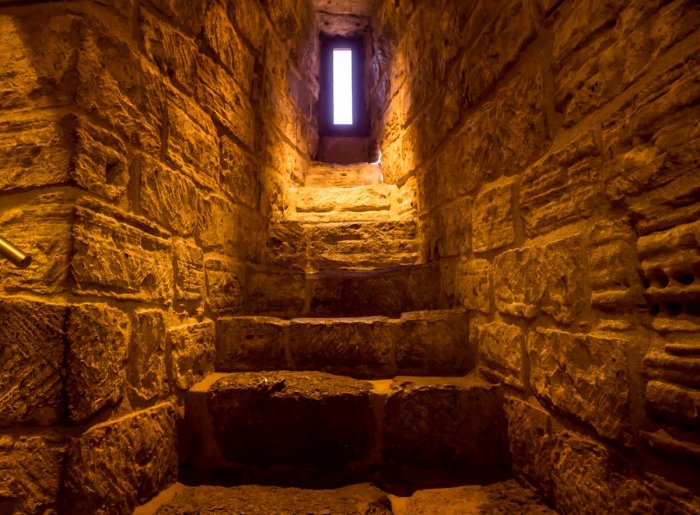
Originally, the tower had a special architectural feature: an opening in the southern wall, opposite the main window. On certain days, sunlight entered the temple through this opening for the first time. The four upper windows followed the path of the rising Sun. Thanks to careful calculations, sunlight moved from one window to another, lighting the space without a break and creating the effect of eternal light that never went out for a moment. This unusual design shows that the ancient builders had a deep understanding of astronomy and spiritual practices. It makes the tower not only an architectural wonder but also a symbol of harmony between people and nature.
Another theory was presented by historian Hasan Hasanov in his book “The Maiden Tower” (2014). He argued that the tower was not built in the 12th century, as many people believe, but in the 8th century BC. His conclusions were based on archaeological finds, a new review of dates that had been changed in Soviet historical studies, and an analysis of written sources. According to him, the Scythian-Saka-Cimmerians built the tower as a religious temple. In later centuries, when the old beliefs had faded, it may have been used as a defensive structure or a lighthouse showing ships the way along the Caspian coast.
Modern researchers often consider the tower to have been built in two stages. The lower part may date back to the pre-Islamic period, while the upper part dates to the 12th century. This is supported by an inscription in Arabic script, “Tower of Masud, son of Davud,” left by a builder or patron among the ancient stonework. It is believed that the first stage of construction was connected with Zoroastrian priests. Zoroastrianism is one of the oldest religions in the territory of Azerbaijan. At its center stand the worship of natural elements, fire, water, earth and air, and strict rules about purity that must never be broken.
According to Zoroastrian traditions, a dead body was considered “unclean” and could be neither buried in the ground nor burned in fire, so as not to defile the sacred elements. Instead, a ritual was used that seems almost frightening to a modern person: the bodies of the dead were left on the tops of structures known as Towers of Silence, where the Sun, wind and birds of prey, such as vultures, cleansed the bones. Some researchers believe that the Maiden Tower may originally have served the same purpose, and then its silence takes on a very different meaning.
Despite these theories, the tower was for a long time officially considered a defensive structure from the time of the Shirvanshahs in the 12th century. However, modern researchers question its military purpose. The tower has very few windows and no arrow slits. Its narrow spiral staircase, lack of connections between the floors and small flat roof do not match the design of a typical fortress. In addition, the inside of the tower was originally one open space without separate rooms, which would have made it hard to keep a large number of people or weapons inside. Defenders would simply have had no room to move.
These features suggest that the tower may have had a religious or other non-military purpose. More and more researchers consider it a possible observatory and a place for religious rituals: a stone turned toward the sky, where time was measured by the movement of the sun.
Alongside scientific theories, local people believe in a legend that has been passed from generation to generation. The story says that, during the Middle Ages, a young woman lived in Baku, the daughter of a powerful ruler, beautiful and kind. She fell in love with an ordinary soldier, but her father did not allow them to marry, because he wanted her to marry a rich foreigner. In despair, she asked her father for permission to build a tower by the sea, where she could spend time praying before her wedding. When the walls had risen and the tower was finished, she climbed to the top, looked at the waves and threw herself into the sea. Since then, the Maiden Tower has become a symbol of tragic love and sacrifice. People still say that in the wind around it you can hear a name the young woman never managed to say aloud.
Comments (0)
Leave a Comment